
CALL US TOLL FREE
888-996-9890

Incline sleep isn't just raising the head of your bed — it's tilting your whole mattress at an angle while it stays flat, so your head ends up higher than your feet. Here's what the research actually says it can — and can't — do, and how that's different from a standard back-raise feature.
"Incline sleep" has become one of the more talked-about sleep positioning trends, but it's often misunderstood. It doesn't just mean raising the head or back the way a standard adjustable base's recline feature does — true incline sleep tilts your entire flat mattress at a gentle angle, head to feet, so gravity works with your body overnight instead of against it. Between wellness blogs and marketing claims, it can be hard to tell which benefits are backed by real research and which are more aspirational.
We went through the clinical and peer-reviewed research on head-of-bed elevation topic by topic, so you can see exactly what's well-supported, what's promising but limited, and how to actually try it — including with the tilting adjustable bases we carry at Bedplanet.
The core idea is simple: your mattress stays completely flat — no folding at the waist — while the entire sleep surface tilts at a shallow, constant angle, typically 3 to 8 inches higher at the head than the foot. Picture a flat board propped up at one end, with your whole body lying on that slope, rather than a mattress bent upward just at your torso.
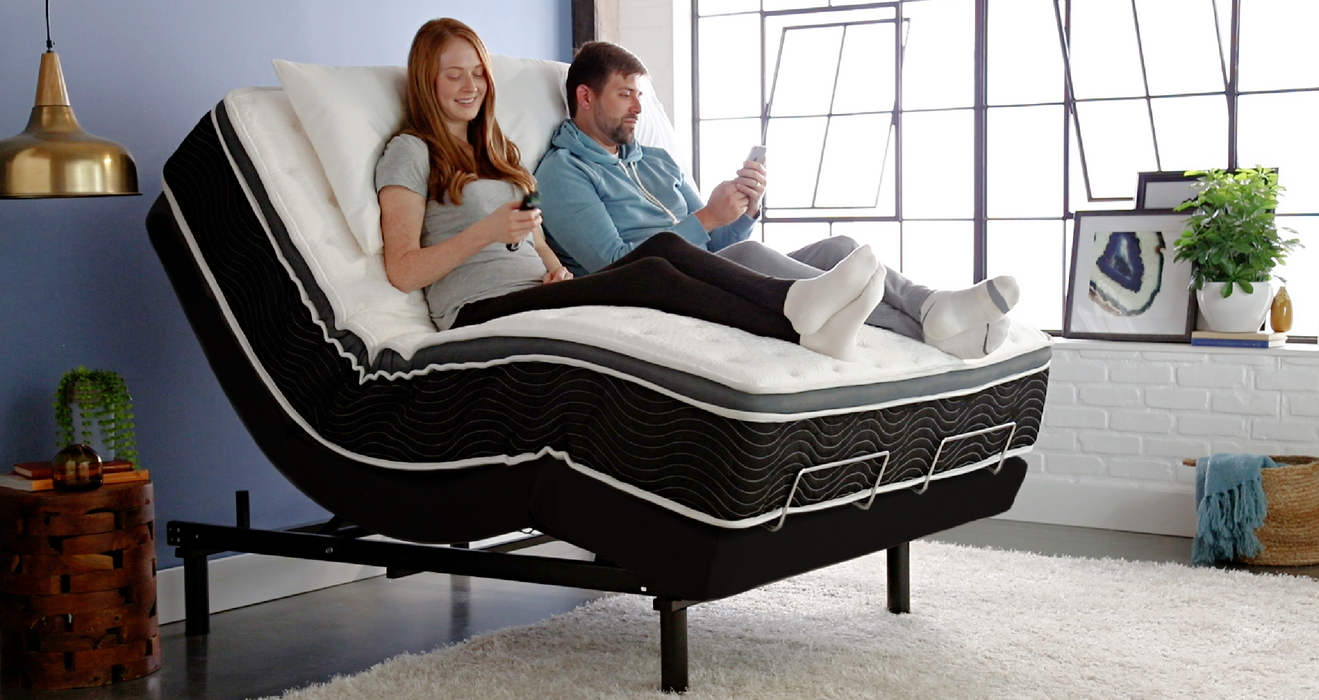
This is an important distinction from a standard adjustable base's back-raise or head-raise feature. Most adjustable bases can prop your upper body up by folding at a hinge near your waist — that raises your head, but it bends the mattress rather than tilting it, and your legs and feet typically stay flat. True incline sleep tilts the whole flat surface, head to feet, which is why it takes a base built specifically for it — like Bedplanet's tilting adjustable bases — rather than just the recline feature already built into most adjustable beds. You can get that same whole-body tilt with bed risers under the headboard legs, a foam wedge under the entire mattress, a purpose-built incline bed frame, or a motorized adjustable base with a dedicated whole-frame tilt function.
Elevated sleeping isn't a brand-new idea. Archaeologists have found that some ancient Egyptian beds and headrests sat slightly higher at the head end than the foot, likely for practical reasons like keeping dust and pests away from the sleeper. As a defined modern wellness practice with specific inch-and-degree guidance, "inclined bed therapy" was popularized more recently, largely through the advocacy of researcher Andrew Fletcher starting in the 1990s. Today it shows up in the clinical literature mainly as "head-of-bed elevation" (HOBE) — the term used in the reflux and sleep-apnea studies referenced throughout this guide.
This is the best-supported benefit of incline sleep. Research on head-of-bed elevation — typically in the 6-to-8-inch range, or about 20 centimeters — shows measurable reductions in nighttime reflux symptoms and esophageal acid exposure compared to sleeping flat. It's a legitimate, doctor-recommended strategy for people dealing with nocturnal GERD, and it's one of the most common reasons people shop for an adjustable base in the first place.
We've written a full breakdown of this specific benefit, including which features and adjustable bases handle it best, in our Best Adjustable Beds for Acid Reflux & GERD (2026 Buyer's Guide).
There's genuine research here, and the effect is real, though it's steeper-angle and more individual than the reflux benefit. One study found a 7.5-degree tilt reduced obstructive sleep apnea severity by roughly 31.8%, and a 20-degree elevation stopped snoring entirely in about 67% of participants studied. A 2025 multicenter study of 45 people with obstructive sleep apnea found that a 30-degree head-and-trunk elevation reduced the average apnea-hypopnea index from 23.8 to 17.7 — a statistically significant drop — with the biggest benefit for people who were overweight or had positional sleep apnea. About three-quarters of participants found the position comfortable enough to sleep in through the night.
That's a meaningful improvement, but it's a complement to treatment rather than a cure. If you have diagnosed sleep apnea, it's worth discussing incline sleep with your doctor alongside CPAP or other prescribed therapy, not as a substitute for it. For a closer look at features that help most, see our Best Adjustable Beds for Sleep Apnea (2026 Buyer's Guide).
Circulation benefits are the least studied part of the incline sleep pitch. The research that exists — a small 2015 study looking at trunk elevation and circulatory volume — involved only male participants and a small sample size. That's a preliminary signal worth further study, not proof of a broad circulation benefit for the general population. If you have a diagnosed heart or circulatory condition, talk with your cardiologist about what's right for you.
This is the least-established part of the pitch. Your body handles detoxification continuously through your liver and kidneys, regardless of sleep angle. Some incline-sleep advocates connect elevation to the brain's glymphatic (waste-clearing) system, but independent medical reviewers describe that link as hypothetical at best — better sleep quality in general may support the brain's overnight cleanup processes, but there's no direct evidence that bed angle specifically drives it. Think of "detox while you sleep" as a nice bonus story rather than a proven mechanism.
Roughly 54% of adults sleep primarily on their side, so it's worth thinking through how incline sleep fits that position. Because a true incline tilts your whole flat mattress rather than bending it at a hinge, side sleepers rest on the same even, supported surface as they would flat — just angled. The one thing worth adding for any side sleeper trying incline sleep is a pillow between the knees, which helps keep your hips and spine aligned in an elevated position, the same way it does when sleeping on your side flat.
Once you know which benefit you're after, the next question is how to actually achieve a true, flat-mattress incline. Here's how the two main approaches compare.
| Feature | Foam Wedge / Incline Frame | Adjustable Base (Whole-Frame Tilt) |
|---|---|---|
| Elevation method | Fixed wedge or permanently tilted frame | Motorized whole-frame tilt, adjustable on demand |
| Adjustability | One fixed height per product | Dial in the exact angle that works for you |
| Reversibility | Difficult to flatten back out nightly | Flat again with one button press |
| Side sleeper comfort | Whole-body tilt, gentler on the spine | Same flat, whole-body tilt — comfortable with a knee pillow |
| Extra features | None — elevation only | Often includes massage, zero-gravity, anti-snore presets |
| Everyday use | Single purpose | Doubles as your everyday bed base |
If you want to have a true whole-body tilt without committing to a permanent wedge or frame, these are three of our most popular tilting adjustable bases — all built to hold a precise incline night after night. Ordered from our lowest starting price to our highest.

Lifts up to 10 inches and tilts up to 10 degrees for independent head and foot incline, plus voice-command control, dual-zone massage, USB charging, and under-bed LED lighting.
View High/Low Lift Bed
Loaded with features: head & foot lift with head tilt for a custom incline, motorized lumbar support, and seven adjustable leg heights — plus an immersive audio experience that sets it apart. VibraSense™ pairs four independent sound pods with vibration technology to turn low-frequency sound waves into a soothing, full-body massage, while ZenMode™ streams over two hours of white noise, nature sounds, or music through the base itself to help you fall asleep faster. Rounded out with dual USB charging and underbed LED lighting.
View DreamSense Opus
Purpose-built for incline sleep, with iTilt technology that tilts the entire sleep surface up to 12 degrees — mattress flat, whole body angled — plus dual-zone massage and under-bed lighting.
View Ergo-Pedic iTilt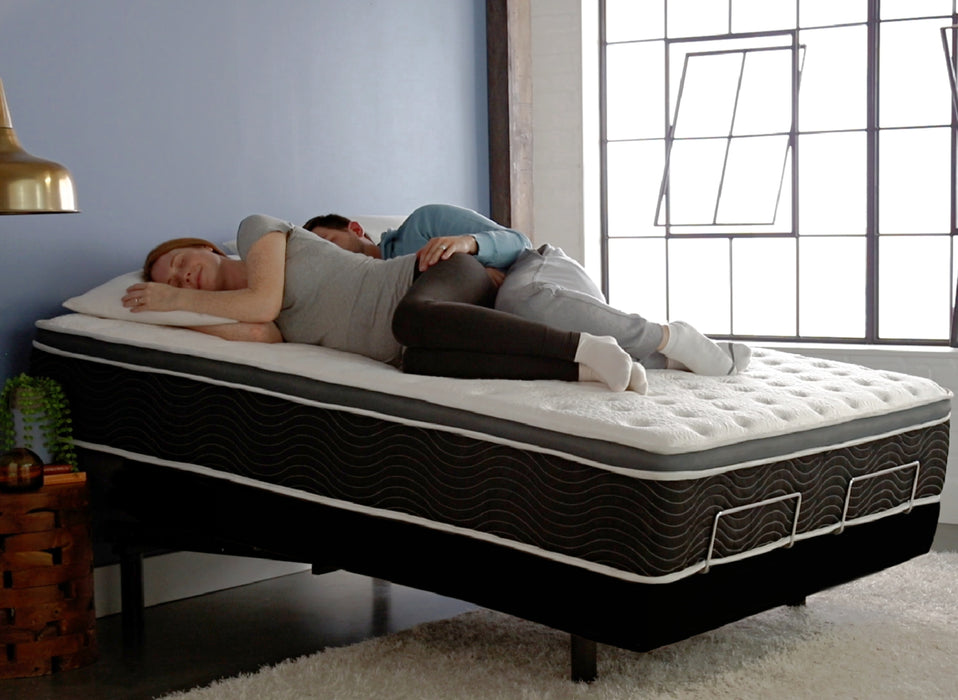

For more options, see our roundup of favorite tilting adjustable bases, or browse the full lineup below.
Shop adjustable bases with a true whole-frame tilt setting and find the one that fits how you actually sleep.
Shop Adjustable BasesThis guide draws on peer-reviewed and clinical sources including PubMed, Sleep and Breathing (Springer Nature), Medical News Today's clinical review of inclined bed therapy, and the Sleep Foundation's sleep position statistics — listed in full below.